We were lazy when we finished the backyard and didn’t dig up the fill sand in the part of the yard closest to the house. Instead, that area got a thin veneer of pebbles.
It wasn’t enough to deter the squirrels, who thought the spaces between the flagstone were perfect for burying walnuts.
I’ve owned a stovetop pressure cooker before and found it to be an appliance that was okay to use. It didn’t live up to its promises (so fast!) but did prepare food slightly faster than the conventional stovetop method. I think my stovetop pressure cooker broke, or I wandered away from it and donated it.
However, I was intrigued by the Instant Pot because it has both the pressure cooking attributes and a slow cooker function. I hadn’t replaced my slow cooker when it broke and I did, from time to time, wish I had another one.
The price was prohibitive, and I’ve been biding my time, figuring eventually someone would have theirs up for sale for cheap because it didn’t quite fit into their cooking routine. However, this weekend Fred Meyer put their 6-quart jobber on sale for $79.99 plus a $10 FM gift card and I snapped it up. It actually rang up even cheaper than that ($59.99) which I reluctantly told the cashier. She shrugged, and let me have it for the lower price.
I’ve had this for two weeks now and can report that I think this will be a permanent and well-used part of my cooking tools. Here’s the reason why: it’s a countertop appliance. Most of my cooking is done in one or two long sessions on the weekend. This means that sometimes space on the burners is at a premium. Being a countertop appliance, I can set something up, program the timer, walk away, and continue doing four other things until the Instant Pot cooking cycle is over. With a stovetop pressure cooker, not only did I lose a burner, but also I had to do a good amount of futzing with the burner setting to maintain pressure.
I love also that I can sauté in the Instant Pot. With my slow cooker, I would have to sauté in a pan and transfer the food to the slow cooker. Otherwise everything came out with the same mushy long-cooked flavor that I didn’t enjoy.
I haven’t yet used the slow cooker function, so I have no report on that, but Steam, Rice, Soup and the pressure cooking functions have worked very well for me. In fact, on Saturday I used the Instant Pot six times, making brown rice, white rice, black beans, red beans, chicken and lentil soup, and Indian butter chicken.
First-time users of pressure cookers might find the time savings to be negligible. You have to let the unit come to pressure, which takes time, and then it cooks at pressure, and then while you can quick release, for some things you have to let the pressure cooker come down naturally from full pressure, and by that time, you could have just done it on the regular stove.
But I was aware I wouldn’t win much time. And unaware of how freeing the Instant Pot would be.
These pictures came out darker than I thought. Apparently I took them at the time of day when my eyes register more light than my camera.
These three houses were mostly boarded up from the inside, so I didn’t notice that they had been vacated. They are on Denver Ave., just off of Rosa Parks Way. They are the type of house I love: small house, bigger lot. North Portland had a ton of these houses when I moved here in 2007. There are fewer now. And soon there will be three fewer.
Portland Maps shows an interesting situation for these houses. Two of them are on the same lot (6541 N. Denver) and the lot seems to extend into the third house, though it has it’s own address (6525 N. Denver). The middle house is not shown as having an address, both on Portland Maps and on Google Maps. However, the information on Portland Maps shows square footage for all three houses in the 6541 N. Denver record and there’s no information on the third house in the 6525 N. Denver record, So I’m assuming all three houses are included on one lot.
The lot was last sold in 1977 for $58,500. According to an inflation calculator, that’s about $231,000 of today’s dollars. I’m unclear if that $58k price reflects that it has three houses on it. In June, this lot sold for [and here I must interject via brackets that the number I’m about to type makes me literally nauseous] $1.6 million.
Wait! It seems the $1.6m is for all three houses on the block, plus the former recycling center on the corner. Nausea has slightly abated. Only slightly. My favorite site Next Portland had this to say on 10/27/17 :
Proposed development of a split zoning site, CG and R5. four story apartment building (20 units or more) on the GC portion of the site and 2 new single family homes on the R5 portion of the site. All existing structures on site to be demoed.
By dividing $1.6m four ways, that roughly pencils out to $400,000 per lot.
Four hundred thousand dollars for just the land. That’s before the demo.
And that, friends, is why we have a homelessness problem in Portland.
Fun fact, I first noticed these houses had been boarded up when I saw one of our neighborhood homeless residents sleeping on the porch of the red house.
Onto the houses. This guy is 600 square feet, with a full basement. It’s the corner lot and has a nice big backyard.
This house is 720 square feet with a full basement. The assessment also includes 500 square feet of concrete which you see in the picture. It serves as the driveway for both houses. This is my favorite house of the three, though I think it has the smaller yard.
This house is 720 square feet with a full basement. It is right next to the former recycling center.
The records don’t say, but I’m guessing houses 2 and 3 were built by the same builder. They look very much the same. There’s a good chance house the first house was built then too. They have a lot of the same lines.
The record on Portland Maps only lists 1922 as a build date and it doesn’t specify if that year applies to all three houses. Either way, I will miss their presence.
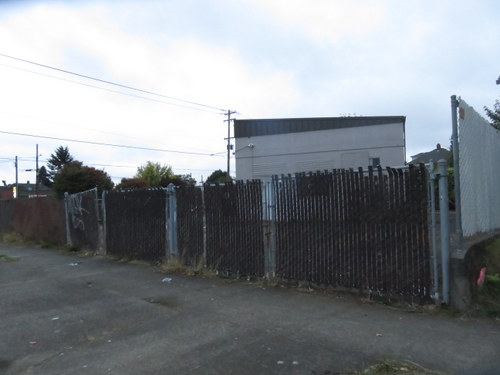
Here’s a side view of where the recycling center used to be. Portland Maps says this garage (it probably was one before it was the recycling center) was built in 1950. I can’t tell if this property was owned by the same person who owned the houses, but my guess is yes. If so, that person made a tidy profit on this sale.
The recycling center (Far West Fibers) closed soon after China stopped taking plastic from the USA, citing too much contamination. It was too bad, as this was a handy place for me to drop off the plastic that couldn’t be recycled curbside.
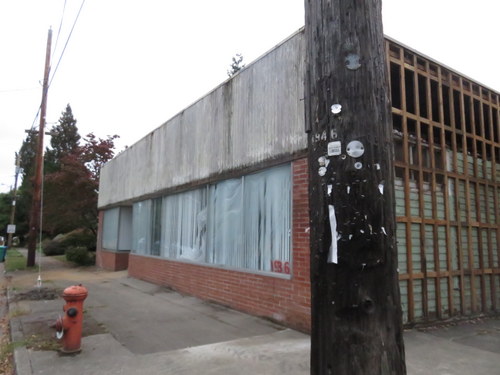
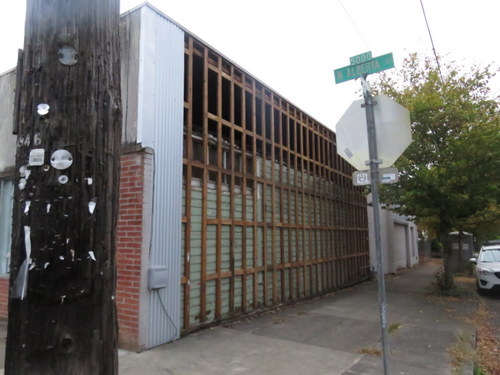
Bonus picture! The property at 1936 NE Alberta. It’s a bit of office/shop space in the middle of a residential neighborhood. These are always a fun find for me. They are almost never shops or offices anymore, as our shopping patterns have changed enough that they are not viable as neighborhood shops.
Today, though, I was even more excited to find this detail.
Exposed: the previous shell of the building. It looks like sometime–I’m guessing mid-twentieth century–this building was revitalized to make it more modern. The sides were built out to make the structure more box-like and the brick was added.
If it weren’t a little too dark, you could see the former slanted roof which has been covered by the more modern flat roof.
Despite its office-looking appearance, Portland Maps lists this as a single family residential building. It was bought in 1994 for $135,000 (about $236k today) and was sold in 2017 for $695,000. The owners live on site, so I’m not sure what their plan is. Live in it? Demo and rebuild? It’s a big enough lot they could. There’s nothing on Next Portland’s development map, so we shall have to see.
Either way, I’m glad I got a chance to peek at what was there before.
I’ve been doing well with the Getting Things Done method of organization and using Google Keep, but I missed having paper to write on. So I bought myself a Leuchtturm 1917 dotted A5 journal (it’s so nice to be able to pop over to Powell’s and pick one up) and got started with this Bullet Journal thing that people have been doing.
I am SO GLAD I started with the Bullet Journal website. The reason? Certain people who post pictures on the internet spend a lot of time on their bullet journals. Which is great for people who want to make watercolor layouts and freehand drawing fancy fonts. But I think those people possibly have too much time on their hands.* I don’t, and need to get things done. This is where the Bullet Journal System comes in. At it’s briefest, it’s a really simple system that can be summed up in one, brief web page of instruction.
*If you are at all interested in the gorgeous things people do with their bullet journals, google “bullet journal inspiration” and marvel. But don’t let it stop you from actually doing a bullet journal, even if your handwriting is terrible and you can’t draw a straight line.
I followed that instruction and now I have an index page:
A future planning page:
And here’s the setup for my October monthly goals and calendar.
In this time of increased commercialism, I appreciate someone who created a simple method to get stuff done. I’m excited to have something to write in and I’ll report back at the beginning of next month as to how it’s been going.
One of the many things I find annoying, now that I’ve sized out of the standard retail sizes, is how ugly a lot of the shirts are. Why do people who manufacture clothing for large women think we want an abundance of 1)ruffles and 2)sequins on our shirts? I don’t want either of those things, and I’ve not met a fat woman who does.
I did, however make a sequin exception for this shirt. I did this in part because there are only a few sequins around the collar, and in part because I loved this paisley pattern.
Somewhere in this house is a photograph of my grandparents and me when I was still a baby. It’s not a great photo of any of the three of us. But my grandmother is wearing a fabulous mid-70s polyester paisley shirt. And so when I bought this shirt, I named it the Grandma Shirt.
It’s been a loyal three-season companion for at least two years now. But it’s worn out, and even I can take only so much paisley.
Thanks, Grandma Shirt, for being such an awesome shirt that I overlooked your sequins.
When we finished the side yard last fall, things weren’t 100% good. There was a section from the fence to the midpoint where the pavers were too far apart. You can see pictures here.
I’m happy to say we’ve fixed this problem by removing the stones, re-leveling the sand and making the stones be closer together. Now I don’t have to mind the gap when I’m walking on the path.
Here’s the section we changed. You can see how we used leftover flagstone to fill the part nearest the house. And you can also see where we stopped for the day. When we picked up the project again, we forgot that flagstone was going closest to the house.
I didn’t notice for a week, and then lacked the enthusiasm to change anything. There are always that don’t match with homespun projects. At least the ones I do.
Closer to the fence we also used flagstone to fill in a gap.
In our work we found 16 walnuts buried by squirrels. Many of them were buried in the two wheelbarrows of sand that sat in the yard over a two week period.
In the interest of fairness to the squirrels, I set all the walnuts we found on the back porch so they could find and bury them all over again.
September reading brought a cornucopia of books, the kind that can only be achieved by take a week-long vacation. (Or perhaps suffering from a bout of unemployment, though thankfully that wasn’t the case for me.) There were a lot of really good books this month, so much so that I’m going to call out more than one in each category.
Picture Books–Grace for Gus Middle Grade–Harbor Me, Taking Care of Terrific Young Adult–The Sun is Also a Star, My Plain Jane Young Nonfiction–Bonnie & Clyde: The Making of a Legend Grownup Nonfiction–How to Instant Pot Adult Fiction–Dietland, Swing Time
Jerome by Heart Scotto/Tallec Read for Librarian Book Group
This books wins on two fronts. I don’t often come across depictions of love between two elementary-aged boys. As someone who did recess duty for nine years, I’ve seen boys become infatuated with each other and the best of friends. I also enjoyed the color scheme (muddy ocher?) and the illustrations which reminded me of Madeline, but in a blurry way.
What didn’t work for me was the lack of context, which set the whole book on the defensive and made it seem like the love the boys felt was wrong. Since the book was going for the opposite message, I would say this was not a successful book.
Mabel and Sam at Home Urban/Hooper Read for Librarian Book Group
A series of adventures Mabel and Sam have while moving into a new house. I loved the sister/brother relationship, especially the take-charge nature of the older sister. The 50s-style drawings were delightful and it was fun to see what the pets were up to while the children played.
Grace for Gus Harry Bliss Read for Librarian Book Group
Grace sneaks out of the house one night to raise some money to support Gus, the class pet. Over the course of the night, Grace partakes in a number of money-raising activities.
I loved Grace’s various money making schemes and I would have been very excited to read this book as a young child. The illustrations are fun, there’s Grace, who is appealing, and there are many details in the illustrations to look at such as headlines, signs and such.
As an “exact words” sort of person I was vaguely troubled trying to figure out if this was a real thing or some sort of extended dream fantasy sequence. But the book itself was so delightful that part doesn’t matter much.
Harbor Me Jacqueline Woodson Read for Librarian Book Group
A very short, beautifully written book about a small group of students who spend the last hour of the week alone in a room talking to each other. As I type the phase “alone in a room” I realize that this would not happen in real life, due to the potential litigation factors of a teacher in the US leaving her students alone in a room together.
Regardless, these students tell their stories as the year progresses. One of the six is dealing with the aftermath of his father being arrested and held for deportation and the tension is built around that situation, but other stories are shared as well. The kids come from different backgrounds and their bonds grow the more they open up to each other.
Also, I like the cover, while also wondering if it leans a little too far to the schmaltzy side of things.
Dead Weight: Murder at Camp Bloom Blas/Muldoon/Seely
A group of campers at a weight loss camp for teenagers finds themselves embroiled in a murder and a mystery. This graphic novel had many different kinds of characters and both the art and the campers’ expressions were enjoyable. I found the mystery wrapped up very quickly in a rather unsatisfying way, but I wouldn’t mind seeing these characters come back together for another book.
Taking Care of Terrific Lois Lowry
I read this book multiple times as a child. It was the first book I voted for for the Young Reader’s Choice Award, one of my many lightbulb memories of reading. I did a re-read to see how it holds up thirty-five years later.
The book is dated in a few ways. There are many early 1980s references that will make no sense to the kids of today and some terms are out of date: namely “transvestites” and “bag ladies”
But man, after this rereading, I think think this book really got under my skin. Was this the reason I moved to Boston after college? Was this the reason I see “bag ladies” as people with complex problems and not an annoyance to society? Was this the reason I love the song “Stardust” when I heard it years later?
The fact that Lois Lowry is a talented and intelligent author is not in dispute, and her skills are on full display here. The primary theme is identity formation. Enid hates her name, pointing out it rhymes with such words as “putrid” and “stupid.” It’s also about making your own decisions about rules. As the summer babysitter of a four-year-old boy she discards many of what she sees as ridiculous rules imposed by the child’s mother.
As Cynthia (the name Enid has chosen for herself) and Tom Terrific (her babysitting charge) spend the summer in the bucolic setting of the Boston Public Garden, there are protests over root beer popsicles, a better understanding of the bag ladies who live in the park, and even some racial justice commentary. That this is all carried out while our characters are busy performing an illegal act makes this story that much more marvelous, though I wonder how parents today would receive its messages.
Burn for Burn Han/Vivian
Hoo boy, this book was so badly written, I started taking notes. It read like the editor had the thought: “these two women have published books individually before, so I need to do no editing for this story.”
This may be a function of two people writing the book, but many details didn’t jibe. For instance, the island has 1000 people who live permanently on it. And there are four middle schools and a high school. This is not statistically possible. According to some quick googling, children make up 24% of our population, which means there are about 250 children on the island. Breaking them down into age cohorts, that’s not even enough to have one middle school, much less four.
Then there was the ferry, whose schedule ran at the convenience of the plot. It ran until 11pm on weeknights. Would a ferry serving an island of 1000 people run that late? The after school ferry is said to arrive at 3:00 and 3:30 in one part of the book, and at 3:00, 3:20, 3:40 and 4:00 in another.
Another inconsistency? The lockers at school have no locks because the island is so safe, but one of the characters lives in a condo complex that has suffered an increasing amount of burglaries.
There were also sentences like this one: “I pinch my hand hard, the web of skin between my thumb and ring finger, just to make sure I’m not dreaming.” The ring finger is the fourth finger, separated from the thumb by the index and middle fingers.
Moving on to the people who populate the book, the characters weren’t very believable, many were not sympathetic or interesting, and at least one of them was terribly unpleasant. There was also some hinting at some supernatural abilities that I couldn’t decide was intentional or accidental. And I don’t buy that the character with the single mother who isn’t very financially successful had a nose job at 16. Where did that money come from?
Finally, and this is the real reason not to read this book, THERE IS NO ENDING. The characters are wondering how things are going to work out on the final page. Presumably, how things work out is explored more in the following books, but I hold firmly to my belief that authors should wrap up one book as they are sowing the seeds of the next one.
The Sun is Also a Star Nicola Yoon Read aloud
This makes for a great read aloud. The short passages, the many side stories, the immediacy of their day keep the words flowing and the pages turning.
Matt was drawn in immediately and was very invested. I enjoyed hearing it a second time.
My Plain Jane Head/Ashton/Meadows Read for Librarian Book Group
The authors who brought us alterna-history of Lady Jane Grey have returned with an alterna-retelling of Jane Eyre. And it was so much fun!
The resulting book is a great mix of the Jane Eyre story layered with a new story. In this one Charlotte Bronte is a student at the same academy where Jane Eyer attends. And also, Jane Eyre can see ghosts.
I admire the world building and the book is quite amusing. They also speak in asides from time to time, just as Bronte did. Here’s a great one:
Reader, your narrators understand Jane has fallen for Mr. Rochester rather quickly. The reasons for this could be threefold: first, it was pre-Victorian England, and courtships could last the length of an egg timer. Second, Jane’s lack of experience with men. And third, Jane’s perception of men, which was gleaned mostly from books that tended to glorify tall, dark, and brooding ones. The broodier the better. And Mr. Rochester was among the broodiest.
There were a few details missed here and there, but overall, this was a great book.
Mr. & Mrs. Bo Jo Jones Ann Head
Someone made an offhand reference to this book in a blog post on the internet and the title, combined with the subject matter, was enough for me to see if they library had it. They did.
The story of couple July and Bo Jo’s accidental pregnancy was contemporary for it’s 1967 publication date and thus, it was a fascinating time capsule of what might happen if a girl got “in trouble” 50 years ago.
In this case, as the title implies, the couple snuck off and got married. The story that follows is one of a young marriage and two people who didn’t really know each other very well before they wed. There are also class differences, which were very interesting. It’s also interesting to see how men and women interact as a couple before the third wave of feminism took hold. My favorite example was Bo Jo saying, “July will get you some coffee” to a friend who stopped by. Nothing makes a marriage happy like commanding your wife to do things.
I found the writing rather staid, but the story was interesting and it read well. It also came with buckram binding, which is rare library treat.
What I Leave Behind Alison McGhee Read for Librarian Book Group
Very, very, very, short book with a male protagonist that explores weighty issues and has a lot of details for having so few words. It’s a good depiction of a character who feels there is little he can do, and who wants to do something.
This was the second book I’ve read in 2018 that heavily references David Bowie. (The Strange Fascinations of Noah Hypnotic was the first) Given that Bowie died in 2016 and Tom Petty died in 2017, can we expect a lot of Tom Petty references coming in 2019?
Bonnie & Clyde: The Making of a Legend Karen Blumenthal Read for Librarian Book Group
A great example of why people of all ages should be reading nonfiction books written for a young adult audience. From the first first sentence, this book is readable and engaging. I loved how it translated things of yesterday into today’s terms. This happens most often with prices of things, but also now I know that a Model A car was approximately the same width as a Ford Focus.
Bluemnthal carefully illustrates the outlaws’ story from different angles, taking time to pick through what details probably stem from legend rather than truth. The book also takes time to recognize the people who were murdered during Bonnie and Clyde’s crime spree and they present their story as a complex one, rather than just a tale of bad criminals.
One small quibble. Given the attention to translating early-20th century things into modern day, I would have expected Bluemnthal to do the same thing when she mentions people’s weight. Bonnie, Clyde, and their associates all grew up in extreme poverty at a time when Americans were smaller from birth to death. Currently, there is a lot of pressure for women and girls to obtain an extremely low body weight, so some context of why a historical figure weighed 81 pounds, and why that would not be the case today, would have been welcome.
Aside from that, this was another great example of the golden age of children’s nonfiction we are living in.
Seeing Into Tomorrow Wright/Curtis Read for Librarian Book Group
Back in the day Richard Wright wrote a lot of haiku. Nina Curtis illustrates those haiku with repeating photos that are assembled into a bigger picture. All of the haikus feature photos of contemporary Black boys, which is great, as photo representations of elementary-school-aged boys tend to be lacking in picture books.
Dietland Sarai Walker
This book succeeds on so many levels: what it’s like to move through the world with a larger-than-“normal”-sized body; what it’s like to be perpetually on a diet; a scathing sendup of women’s place in American culture; a brilliant satire. It’s also amusing throughout.
Just as part of me responded to the false world created in Chuck Palahniuk’s Fight Club so did I respond to the feminist terrorist organization called Jennifer. When an author gets this much right with her first novel, I can’t wait for her next book.
Swing Time Zadie Smith
Something about Zadie Smith’s writing makes me want to curl up and not stop reading until all the many pages of the novel have been read. It doesn’t even matter who the characters are. So it was with this book.
How to Instant Pot Daniel Shumski Shumski discards the usual cookbook setup (Appetizers, Soups, Main Dishes, etc.) and instead arranges recipes by Instant Pot function. As there is a learning curve with the appliance, this is appreciated.
I also enjoyed his humor and the fact that he did not have a lengthy list of desserts which could be made in the Instant Pot, but which no one will ever make. I’m buying this cookbook, which is a rare move for me. Well done Mr. Shumski!