Wardrobe Architect: Defining A Core Style

The Wardrobe Architect
If you want to choose your clothing with more thought and care, follow along with Coletterie and their series.  This is week two.
When you are wearing your favorite clothing how do you feel?
Purposeful, classy, unique
When you’re wearing something that is not quite right, how do you feel?  What are the feelings you want to avoid about the clothes you wear?
Fat, slobby, hobbit. (You know that part in the movie Juno where Juno points out Paulie Bleaker’s mother looks like a hobbit?  As a short person with some heft, that line struck fear into my heart.)
Who do you consider to be your style icons?  What is it about them that appeals to you?
(This was a hard question as I don’t really think about “style icons”)
Audrey Hepburn–clean lines, always looked classy
Michelle Obama–not a small woman and likes bold things
Drew Barrymore–whimsical and sophisticated
What are some words that describe styles that you like in theory, but are not quite you?
Elegant–I’ve got too many real things I have to do in clothing, so it has to be sturdy.
Boho–makes me feel sloppy, also like a two-ton-tilly
Fashion Forward–I have no time to keep up with that stuff.  Also the money.  And the fact fashion isn’t really made for people of my shape.
Look over your answers from last week on history, philosophy, culture, community, activities, location and body. Last at least 15 words that you associate with your answers.  Think about descriptive words, moods, and feelings you associate with those feelings.
Classic, clean, strong, feminist, feminine, dressed up, comfortable, WASP, thrifter, laid-back, accessible, walkable, flirty, rain-proof, fit, structured.
Are there other words you would like to add to this list?  What other words describe your core style?
Colorful, practical, well-made, long-lasting
Look over the answers to all of the questions above.  If you had to narrow your list to only 3-5 words to describe you, which words would you choose?
practical, classic, walkable, comfortable, structured.
Collect 15-20 images that represent these 3-5 words for you.
I made a Pinterist board.  It was a difficult exercise because I wanted to pin images of women who look like me and had trouble finding them.  But I did it and you can see the results by clicking here.

Essay: Marching Band Part II

More regurgitating of band memories.  Feel free to add your own in comments.
Marching band was a temperature slide—unbearably hot at the beginning and freezing cold by the end.  It was a lot of standing around quietly to learn something that was all sound and music.  Marching band was a dusty field, hideous unflattering uniforms and free admission (but sadly for me, mandatory attendance) at all the football games.
The first two weeks of practice we cranked things out.  To begin, JP would show us a diagram of what we were going to do.  He hand wrote our marching patterns on gridded paper shaped like the football field.  I figured out later he also hand-wrote arrangements of our music.  JP was one of those teachers who rankled me—his use of “gals” paired with “guys” came off as sexist and he was old and had that slightly jokey authority figure nature that was kind of hard to buy.  There was also a lot of imploring.  But when I think of the logistics of setting a hoard of musicians and dancers marching around a 100-yard field, my mind boggles.
With the day’s pattern in mind we would run through the music—we were supposed to be memorizing it, and ideally have it pretty much down by this point—and then head out to the field.  As with all large groups, this took forever, and thanks to the fact we all had instruments, it came to pass with a lot more noise than necessary.  The band room was separate from the school, tucked off the back of the gym.  Our practice field was across the loop of road that circled the school.  The football team’s field was further—they took up the middle of the track, and maybe another field off the side.  Sometimes they would cut through our field on the way back in from their own practice.  The band ignored them, though the drill teamers chattered with them.  In my school, football and band did not cross paths, except for the one guy who did both.
Once we straggled out and into position, we would make some attempt at pulling ourselves together.  Various attempts by various people were made to be more military and attentive in our practices, but they lasted a day at most before we devolved into talking and “horsing around” while JP used his megaphone to grab our attention long enough to get us started.
What I remember most about marching band practice was standing around.  We’d run a bit of the show, then screech to a halt—though there were always one or two in the bass section that just had to keep playing.  Then, most of us would stand at attention, while JP fixed something on some other part of the field.  “Attention” often had a half-life of three minutes before we would start to murmur to the person next to us, to quietly play a few measures, or start to spin or sway in our spot.  When the pause was very long we would resort to gymnastics—one guy could do a front flip with no hands and a lot of us did cartwheels, or pushups (meted out as punishment, but actually fun).  We also burst into song at regular intervals.  For decades now, I’ve been singing the line“the check’s in the mail, you’re beautiful” at appropriate moments, because that was in regular rotation for a time on the marching band field.  The boyfriend pointed out it was a line from a Werid Al song.

All that standing around must have led to something, because eventually, we had the entire program running.  I didn’t know it at the time, but there’s something magical about creating both music and patterns on a football field. And I had no idea of the incredibly brief lifespan of that magic.  After high school, I never marched again.  It’s not really an activity that lends itself to the adult world.

Wardrobe Architect: Designing and Building Thoughtful Attire. Week One. Making Style More Personal.

The Wardrobe Architect
Colette Patterns has a blog called the Coletterie where various things to do with sewing, fashion and the like are discussed.  This year they are launching the Wardrobe Architect, which is a way for us all to think carefully about the clothing we acquire.  Here’s a link to the introductory post.  Each week there is an activity which will build on the previous week’s activity.  
This week’s activity had a worksheet to complete.  Here are my answers.
History:
How has your personal history informed the way you dress?  When did your tastes crystalized?  How have they changed over the years, and why?
I like a neat and tidy look and I like comfortable clothes that are feminine.  I like dresses and skirts  and styles from the 50s.  I think this came about in high school/college when I felt the design choices from that era offered me more choices than my own era.
Philosophy:
How does your philosophy, spirituality or religion affect your aesthetics and buying habits?  Or what aspects of those things would you like to see reflected?
I like to make an effort to look nice and dress up when the occasion calls for it.
Culture:
How has your cultural background shaped the way you look?  How did the aesthetics and values you grew up with affect your tastes as you got older?
I don’t really feel like I have a culture. However, growing up “bigger” meaning I was always on the larger end of whatever clothing scale affected me.  For example, I was a 9 or 11 in junior sizes, I’ve been a 12 or 14 for most of my adult life.  Because of this, I often feel like there isn’t clothing for me, that clothes are designed for people much smaller (and now much, much smaller).  So I hate shopping for clothing because every time I can’t find something in my size or something ostensibly in my size doesn’t fit, I feel like a failure.  In some ways, thrift stores and second-hand shops are easier because there is just one of each item, so it either fits or it doesn’t and I don’t have to go back and find a bigger size or be frustrated that there are four more of the size 00 and six of the size two but none in the size that fit me.
Community
How are you influenced by the people around you including friends, family and other communities you’re involved in?
Portland is very laid back, but I also think there is a total clotheshorse aesthetic going on here that no one really acknowledges. It may not be the same high-fashion aesthetic of other cities, but people here have style.
Activities
How do your day-to-day activities influence your choices?
I need to be able to walk in my clothing which means no heels, comfortable shoes.  And I like my clothing to be comfortable, meaning I don’t want to step out of them the minute I get home.
Location
Does the place you live inform the way you dress?  How does climate factor in?
Dresses in the winter mean tights and I sometimes don’t want to deal so I will wear pants instead.  I need some good leggings that are not too long.
Body
In what ways does body image affect your choices in clothing?  What clothes make you feel good about the body you live in?  What clothes make you feel uncomfortable or alienated from your body?
too tight = alienated.  Things that fit just right are fabulous.  In general, I like my clothing to have some structure.  I currently have pants that can stretch every which way and I can’t stand them. I need regular objective feedback about my size that clothing that doesn’t stretch gives me.  If something has just been washed and is too tight, I need to step up the exercise and watch what I’m eating a bit more.

Postcard from Germany

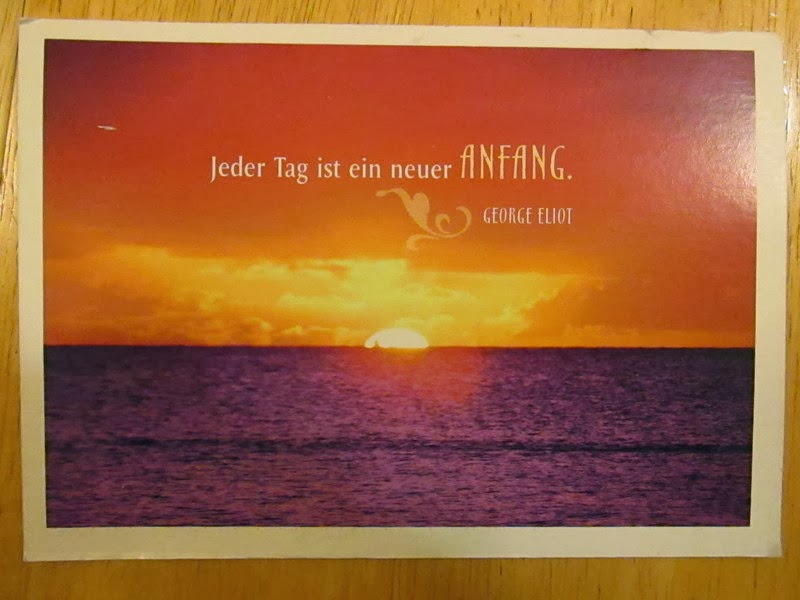
In your Postcrossing profile you can say what you like and I mention that I collect quotes and ask people to send me their favorite.  So sometimes I get quotes written on the cards by the senders and sometimes people send me postcards with quotes on them.  This is from Anne who is a retired teacher and is collecting quotes from all over the world.  So we have that in common. She translates this as, “Each day is a new beginning.”

A Manhattan-off

My Cocktail Book author said, “sometimes you just have to sit down and do the taste test to find out if you are a Bourbon whisky Manhattan person or a rye whisky Manhattan person.”  A. and I accepted his challenge and did just that.  The result?  We are both Bourbon whisky Manhattan people. But we think maybe with lemon garnish instead of cherries, we might enjoy rye whisky Manhattans.  Further tests will ensue.

A stick-to-your-ribs soup.

The first time I made this soup I peered at the finished product and said, “Ugh.  Doesn’t look too great.”  Then I actually ate it and changed my tune. It’s incredibly flavorful, packed with umani flavors.  Some of the ingredients are not ingredients I have on hand on a regular basis, like the seaweed, but I’ve made this several times and it’s just what the doctor ordered on a freezing cold morning.  
To make it yourself, follow the link to Eating Well’s Tofu and Vegetable Stew.

2013 Mock Printz

I attended another great Mock Printz Workshop where we read and discuss great YA literature and try to guess what the Printz Committee will pick as the best YA book of the year.
Here was our schedule.

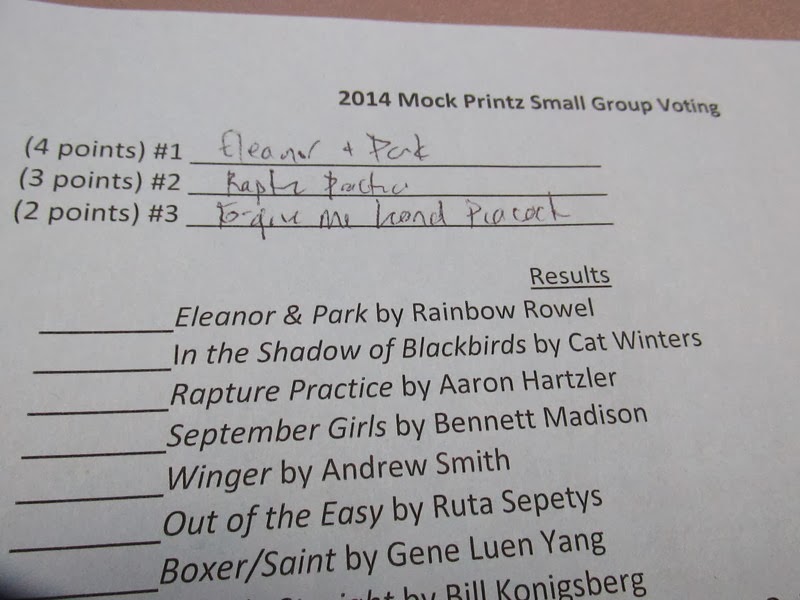
Here were my votes.
After a few rounds of voting we came up with the following winners:
Eleanor and Park by Rainbow Rowell with 113 votes
Forgive Me, Leonard Peacock, by Matthew Quick with 86 votes
Boxers/Saints by Gene Luen Yang with 71 votes.

Now we wait for the announcement on 1/27.